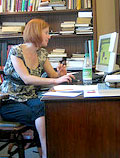
Olsson's: Recommended Reads

Olsson's is a locally Owned & Operated, Independent chain of six book and recorded music stores in the Washington, D.C. area, started by John Olsson in 1972. Elizabeth Frengel worked at Olsson's Lansburgh/Penn Quarter store before joining the office staff. Each week, she sends out a rundown on some of her favorite reads.

Wednesday, April 25, 2007

Philip Larkin: Collected Poems

Warning: You might want to stay away from this collection if you're really down.

On the other hand, if you're just sort-of down, then the work of Philip Larkin could well be the thing to set you right.

A man after my own bookish heart, Larkin studied at Oxford, became friends with Kingsley Amis and Bruce Montgomery (musician and writer of detective fiction under the nom de plum Edmund Crispin) and eventually went to work as a librarian at the University of Hull in 1955. He's said to have transformed that teeny nook into one of the best libraries in Great Britain. He also showed early precociousness as a poet, publishing in the BBC's weekly almost as soon as he got to Oxford and later being anthologized in Oxford Poetry, 1942-43 and Poetry from Oxford in Wartime.

After graduation, Larkin went on to publish two novels -- Jill and A Girl in Winter as well as several books of poetry, all of which (The North Ship, The Less Deceived, The Whitsun Weddings and High Windows), in addition to uncollected poems from 1940-1984, are included in this edition.

Moody, bleak, achey, and often oh-so-dead-on, Larkin seems to have written a poem to match just about any frame of mind or physical state, which is why I find his work so oddly uplifting.

For instance, sometimes when you're disappointed or wronged, you have a perverse urge to hang onto the hurt and worry it like a loose tooth. Larkin's obviously been there:
If grief could burn out
Like a sunken coal,
The heart would rest quiet,
The unrent soul
Be still as a veil;
But I have watched all night

The fire grow silent,
The grey ash soft:
And I stir the stubborn flint
The flames have left,
And grief stirs, and the deft
Heart lies impotent.

Notice how clearly, almost effortlessly, Larkin depicts such a twisted-up feeling?

On the flip side of that poem about not letting go is this one, a perfect depiction of hope renewed and perhaps my favorite in the collection:
The horns of the morning
Are blowing, are shining,
The meadows are bright
With the coldest dew;
The dawn reassembles.
Like the clash of gold cymbals
The sky spreads its vans out
The sun hangs in view.

Here, where no love is,
All that was hopeless
And kept me from sleeping
Is frail and unsure;
For never so brilliant,
Neither so silent
Nor so unearthly, has
Earth grown before.
Without delving into a technical analysis, I have to say that in general, the cadence of Larkin's work is high among its many pleasing traits. Another is its emotional range. And what's not to like about a poet who's so easy to understand?

Philip Larkin: Collected Poems is available from Farrar, Straus and Giroux for $15.

Enjoy,
Elizabeth Frengel
Thursday, April 12, 2007

Mate in Two

Book CoverThe Queen's Gambit, by Walter Tevis, is one of those rare (not in that sense) books that no sooner had I finished it, I wanted to go back and start reading from the beginning. It's that good.

It's the coming-of-age story of Beth Harmon, orphaned at eight and sent to the Methuen Home in Kentucky, where she develops an institutionally-induced drug habit and an obsession with the game of chess.

I should 'fess up and say I like chess and even play a little. Very little. Nothing like Beth, whose assent as a child chess prodigy inevitably takes her to the U.S.S.R. in a bid for the world championship. Unlikely, perhaps, for an orphaned eight-year-old who, as punishment for stealing tranquilizers from the infirmary, is forbidden from playing in her most formative years. But the narrative suspense doesn't let you stop to ponder this.

On the other hand, Beth encounters very likely sexism in the sport (when she tells Methuen's janitor that she wants to learn the game he plays solo in the boiler room, his curt reply beautifully sets up the battlefield: "'Girls don't play chess.'") and spends most of the book warring with demons both on and off the board. She's a brutally honest and interesting character study.

You don't have to play chess to understand The Queen's Gambit, but it helps to have some sympathy for the game's seduction. Even so, Tevis describes the matches in a way that gives just enough details about the moves to convey their tense psychological and aggressive implications.

The Queen's Gambit is yours from Vintage for just $12 -- and worth every cent.

Book CoverIf you like the sound of that (or have read it already), then you can't miss The Flanders Panel, by Arturo Perez-Reverte.

When a young art conservator begins work on Pieter Van Huys' The Game of Chess, she uncovers an inscription hidden for nearly five centuries: Quis necavit equitem, or Who killed the knight?

A game of chess ensues both literally and metaphorically as the conservator tries to solve the historical riddle posed by the painting and those with less humanist interests make shady plays for the priceless van Huys.

What's startling about this novel is not so much the chess playing (though it's good here, too) as it is Perez-Reverte's description of the painting. I did a little bit of research to see if Huys (Flemish, 1520-1584) in fact painted such a work as The Game of Chess. I don't think he did -- but you'd never guess it from the fine visual detail found in this book.

Capably translated from the Spanish by Margaret Jull Costa, The Flanders Panel is available from Harvest for $14. Again, well worth the investment.

Happy reading,
Elizabeth Frengel
Thursday, April 05, 2007

Quick List

Hello, bibliofans. I have to apologize for my column, which has been a bit spotty of late. It's not that I've not been reading (I'll give you a run-down of what in just a sec). It's that I've been procrastinating on a few research projects necessary for my library degree and, well, things kind of caught up with me.

Plus, Alexandra (head of book ordering) was kind (or cruel) enough to lend me the entire Upstairs, Downstairs megaset on DVD (some 70 hours of viewing), which she borrowed from another friend who shares our affinity for anything Brit -- and I couldn't not start the view-a-thon. Could I?

But I do promise to be back next week with a full (and enthusiastic) review of two very excellent books on one of my favorite obsessions: the game of chess. If you want to read up ahead of time, check out The Queen's Gambit, by Walter Tevis and The Flander's Panel, by Arturo Perez-Reverte. They're two radically different approaches to the subject -- one is a coming-of-age story and the other is a mystery/suspense -- but if you like chess (even just a little), I promise you won't be disappointed.

I'd also encourage any Strong Poison fans to check out the link that reader Bill Peschel sent in to his Web site. You'll find all kinds of facts, sources and fun quotes in this annotated guide to the novel.

And, finally, I'll give you the quick list of books I've been reading in the past week or so and will, in all likelihood, chat about in the future. One is called Please, Mr. Einstein, by Jean-Claude Carriere -- a clever portrait of Einstein (the physicist) presented from the point of view of a young woman journalist who slips through a crack in time and space to meet up with Einstein (and a few other notable figures) in his study. I'm also reading Collected Poems by Philip Larkin. If you like Larkin, one of these read every day will make your day. The last on the list is Disordered Minds -- a psychological thriller by British author Minette Walters. 'Nuff said.

I promise a return to normal next week.

Until then, happy reading.
Elizabeth Frengel
Staff Photo

Elizabeth Frengel

Elizabeth Frengel writes about good reads – from classics on the brink of obscurity to contemporary kids’ books. She’s especially interested in between-the-wars European lit and is an unabashed Anglophile and connoisseur of the British mystery. In addition to having served her time at Olsson’s at the Lansburgh location and in the office, Elizabeth taught writing at American University. She will soon step into the role of manager of reader services at The Society of the Cincinnati.

Powered by Blogger