|
|
Olsson's: Recommended Reads
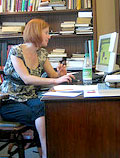
Olsson's is a locally Owned & Operated, Independent chain of six book and recorded music stores in the Washington, D.C. area, started by John Olsson in 1972. Elizabeth Frengel worked at Olsson's Lansburgh/Penn Quarter store before joining the office staff. Each week, she sends out a rundown on some of her favorite reads.
Thursday, January 31, 2008
Letters to Katie
Okay, team. This week's pick just about counts as a step toward my new year's resolve to read more nonfiction. I slipped in that qualifier because Edward Burne-Jones's highly imaginative Letters to Katie could hold their own among even the most compelling narrative fiction.  You're likely to recognize Burne-Jones as one of the stars among the Pre-Raphaelite constellation of nineteenth-century painters, who produced works that pondered classical mythology and the days of King Arthur and his chivalric ilk. His relationship with Katie Lewis, while having nothing to do with romance or myth, is an intriguing one nonetheless, especially as evidenced by this collection (officially titled Letters to Katie from Edward Burne-Jones and published for the second time by the British Museum in 1988). Katie Lewis was the youngest daughter of Burne-Jones's close friend, the solicitor and baronet George Lewis. Long before Burne-Jones became a successful painter, he made a habit of illustrating his letters. And Katie, by all accounts a precocious child who dubbed her family's artist friend "Mr. Beak," was the lucky recipient of a string of these letters from 1882 (when she was aged 4) until Burne-Jones' death in 1898.  Clearly Burne-Jones felt just a wee bit more than a paternal fascination with Katie, at times speaking to her childishly to gain her childish sympathies and at others speaking to her as if she were his peer. He knew just how to turn even the smallest intimacy into a charming inside jest, such as in Letter XIV, where he writes to Katie about a litter of newborn pigs: Well--what do you think? it has had ten little ones. and i don't know if they are scarfs and i don't know what to call them and each must have a name and i don't think there are ten names in the alphabet and they all want winding up like their mama -- and squeal if they are not wound up -- and it takes such a time -- their names will be 1. Smith 2. Jezebel 3. Dinah 4. Bill 5. Winder 6. Friday 7. Piccadilly 8. Patience 9. You 10. me A note on the text tells us that Katie mistakenly called a "calf" a "scarf." But even if you didn't know that, there's no mistaking the letter is built upon the imaginary bond that existed between Burne-Jones and Katie. And most of what he writes is pure fantasy.  Many of the letters are loaded with double-meaning, because surely Burne-Jones meant for the correspondence to be read by Katie's parents. Hence their literary appeal. I think my favorite on this score is one in which Burne-Jones describes buying a doll to compete with Katie's. When he has the doll's frocks made by Madame Elise in Regent Street, the doll begins putting on airs and getting ideas above her station and Burne-Jones no longer knows how to cope with her. A timeless conundrum... Sadly, this collection is no longer in print, though second-hand copies are fairly easy to find. I'd highly recommend keeping your eyes open for one. Happy reading, Elizabeth Frengel
Thursday, January 17, 2008
Angel in Distress
How are the new year's resolutions working out? I guess I should confess to having already broken mine. I was transfixed by Elizabeth Taylor's Angel - I couldn't look away! - and so it's technically not my fault. I recommended Taylor's Mrs. Palfrey at the Claremont (see May 10, 2007) and this is just as good - better, I'd say - but a very different book.  For starters, you don't know whether to laugh at or weep for Angelica Deverell, who's so much the center of this novel, I promise she'll redefine your notion of self-centeredness. The year is 1900 and Angel (irony intended, I assure you) is 15 and the unhappy student at a private school, the fees for which Angel's widowed mother labors impossibly long hours to meet. Angel's milieu is English working class, and imperious and discontent, she rejects it totally. Instead of applying herself to her studies, gaining a skill, or god forbid, helping her mother, Angel spends her days weaving elaborate fantasies. The more she daydreams, the more intolerable life on Volunteer Street becomes. To her mother's horror, Angel quits her coveted place at school to write a novel. As laughable as this may seem (and after a bit of flailing) she makes a success of it. But even her publisher and reading public aren't sure whether to laugh or cry. The style is high-flown, the plot preposterously romantic, and manners iffy. In short, it's delusion. But there's always a market for that. You get a good taste of what Angel is like from the novel's first few paragraphs: "'into the vast vacuity of the empyrean,'" Miss Dawson read. "And can you tell me what 'empyrean' means?" "It means," Angel said. Her tongue moistened her lips. She glanced out of the classroom window at the sky beyond the bare trees. "It means 'the highest heavens'." "Yes, the sky," Miss Dawson said suspiciously. She handed the exercise book to Angel, feeling baffled. The girl had a great reputation as a liar and when this strange essay had been handed in - "A Storm at Sea" - Miss Dawson had gone through it in a state of alarm, fearful lest she had read it before or ought to have read it before. The funny thing about this book is that I couldn't help feeling sympathy and a disconcerting respect for Angel, as hateful and as arrogant as she is sometimes portrayed. Angel bullies her mother, scoffs at her aunt (who could step straight out of an episode of Upstairs, Downstairs) but at the same time harbors an endearing tenderness for animals of any sort. (The string of pets in Angel's life make great characters, too, from Sultan to Silky Boy.) Her husband is unfaithful; her publishers and critics fear and mock her. Yet she is always reaching for something more - the vast empyrean. She's at once distasteful and wholly pathetic. As the arc of this novel follows Angel through her life, you see her infinite capacity for both determination and delusion. Taylor is such a keen observer of the tragicomic in life and this is writ large in the character of Angel. Taylor's works have been reissued by Virago Press, and you can pick up Angel for $13.95. I highly recommend it. Happy reading, Elizabeth Frengel
Thursday, January 03, 2008
A Short List for 2008
Happy new year, bibliofans! I hope you've all resolved to read more books. It goes without saying that I have. If you're anything like me, the piles by the bedside are reaching alarming heights. This year, however, I've resolved to read more nonfiction. Namely, Agatha Christie's autobiography titled Come, Tell Me How You Live, a witty and incisive account of her travels in Syria accompanying her archaeologist husband, Max Mallowan. (I'm guessing this is where she got some of her material for such Middle East-inspired classics as Murder in Mesopotamia, Death Comes as the End, and They Came to Baghdad, to name a few.) I got my copy from the library, but as far as I can tell, the book is still in print and available from Akadine Press ($18.95). Also: a collection of essays on painting called Mysteries of the Rectangle ($18.95) by Siri Hustvedt, whom you may recognize as the author of the novel What I Loved (also on the TBR pile). And another book about chess, this nonfiction, called King's Gambit: A Son, a Father, and the World's Most Dangerous Game, which was published this fall and is available for $24.95.  But before I set out on my reality-driven 2008 reading plan, I thought I'd see out 2007 with one from Ruth Rendell. The Chimney Sweeper's Boy (Simon & Schuster, $14.95), which she wrote under the nom de plume Barbara Vine, proves itself a deliciously tangled web of fiction. When the daughter of acclaimed author George Candless is asked to write a memoir of her recently departed father, she quickly discover that he wasn't at all the man everyone assumed him to be. Woven into this psychological thriller are portraits of rejection, manipulation, emotional cruelty, secrecy, alcoholism and of course, heaps of Rendell's signature literary allusions. What I like best, perhaps, about The Chimney Sweeper's Boy is how in attempting the write a biography of her father, Sarah is forced to revisit his novels (and he was quite prolific), which sparks an obsessive and futile quest to sort out fact from fabrication. Are the characters based on people Candless knew? Did he experience the events he describes so cannily? Suddenly every detail takes on ominous significance, from a palm cross in the writer's desk drawer to a black moth that appears on his books' dust jackets. At the first go it may not seem so, but The Chimney Sweeper's Boy is in fact a very clever work of metafiction. Plus, each chapter begins with a pithy epigram taken from the fictional Gerald Candless's works of fiction. Are they clues to his identity? I'll leave it to you to find out. I've not read all of Rendell's work; yet of what I've read so far, I do tend to favor her writing as Barbara Vine. Check out the Edgar-winning A Dark-Adapted Eye as case in point. And if you've not yet gotten around to A Judgement in Stone, I'm going to ask what you're waiting for. Rendell's works are, in my mind, psychological fiction at its best. Happy reading, Elizabeth Frengel
|
Elizabeth Frengel
Elizabeth Frengel writes about good reads – from classics on the brink of obscurity to contemporary kids’ books.
She’s especially interested in between-the-wars European lit and is an unabashed Anglophile and connoisseur of
the British mystery. In addition to having served her time at Olsson’s at the Lansburgh location and in the office,
Elizabeth taught writing at American University. She will soon step into the role of manager of reader services at
The Society of the Cincinnati.
|