|
|
Olsson's: Recommended Reads
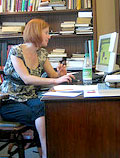
Olsson's is a locally Owned & Operated, Independent chain of six book and recorded music stores in the Washington, D.C. area, started by John Olsson in 1972. Elizabeth Frengel worked at Olsson's Lansburgh/Penn Quarter store before joining the office staff. Each week, she sends out a rundown on some of her favorite reads.
Friday, May 30, 2008
A Far Cry From Kensington
 I just love the title of this quiet masterpiece from Muriel Spark, originally published in 1988 and just reissued in a special cloth edition reprint from Virago Modern Classics. The past cries out -- literally and metaphorically -- to Mrs. Hawkins during the sleepless nights she spends reflecting on a period in her life when she worked in publishing and lived in a bed-sit in what was, in the 1950s, a down-at-the-heels section of South Kensington in London. Ah, how times have changed. But for Mrs. Hawkins (everyone, perhaps because she's a massively overweight war widow and easily confided in, refers to her as "Mrs. Hawkins," even though she's just 28) that period in her life is as sharp and coherent as if it had all unfolded yesterday. One of the things I found so appealing about Mrs. Hawkins (and the novel) is her brutal honesty, with others and with herself. She revisits and replays events from this period of her life until she's sure she's gotten to the truth of them -- such as the piteous cry uttered from one of her fellow lodgers when she receives an anonymous letter -- its a cry that echoes in Mrs. Hawkins' memory until it becomes a kind of refrain. Then there's the unexpected invitation to dine at the Ritz, which the still-too-plump Mrs. Hawkins receives from an attractive man she meets by chance in church. If you know Muriel Spark at all, you know that her narratives tend to kaleidoscope from splinters of incidents and scenes that seem unrelated and unordered into a sweeping panorama that offers brilliant insight into character and psychology. A Far Cry from Kensington is no different in this regard. It also offers a wry send-up of the London publishing scene with its debtors, eccentrics, high-maintenance authors and bottomless well of hangers-on. One particular hanger-on, called Hector Bartlett and ruthlessly laid bare by Spark, proves trouble not just for Mrs. Hawkins, but for several others in this story. Mrs. Hawkins has the nerve to call him a pisseur de copie -- a urinator of hack prose -- directly to his face. What would be a coup de grace for integrity costs her more than one highly coveted job in publishing. A character quirk has Mrs. Hawkins constantly dispensing advice -- to the increasingly deranged Polish seamstress, who lives in the flat below her, to another neighbor, young and naive and seeking that ever-elusive job in publishing, and to would-be authors. Here's just one small example: Now it fell to me to give advice to many authors which in at least two cases bore fruit. So I will repeat it here, free of charge. It proved helpful to the type of writer who has some imagination and wants to write a novel but doesn't know how to start.  To see Mrs. Hawkins sage advice -- and it's good, I promise you -- you'll have to pick up your own copy of A Far Cry from Kensington. I bought mine in London, and as I far as I can tell, the cloth-covered Viragos aren't available in the States. But you could keep your eye out for a second-hand copy and meanwhile check out one of Spark's more readily available works, including The Prime of Miss Jean Brodie, The Girls of Slender Means and Memento Mori. Everyman's Library has four of her novellas in one volume for just $20. I can highly recommend all of them. Until next time, Elizabeth Frengel
Wednesday, May 21, 2008
Another Bookish Holiday...
Just back from London and had a marvelous time (is it possible to have any other kind?).  For a little atmosphere, I read Marie Belloc Lowdnes creepy London classic, The Lodger on the outbound flight. Based loosely on the Ripper murders in the 1880s, this novel delves into the weird psychology of what it would be like to discover you're sheltering a murderer. I don't know why it is, but the lodger's eccentricities bring to mind Jeremy Brett's Sherlock Holmes almost to a T. Odd, but there it is. And definitely no less enjoyable because of the characterization. Of course I couldn't be in London without dropping by Maggs Bros at 50 Berkeley Square. (For new readers, Maggs is the site of the amazing internship I lucked -- with lots of help from my friend, Julian Wilson -- into this past summer.) I was in the front shop, browsing the shelves, and as coincidence would have it, my eyes fell straight onto a 1932 edition of said Lodger, inscribed by the author to an aspiring writer, for £100. Tempting, to be sure.  My next stop was just around the corner, the famous bookshop at 10 Curzon Street: Heywood Hill. You may remember my mention of the book by the same name, The Bookshop at 10 Curzon Street, which contains letters between the shop's founder, Heywood Hill, and Nancy Mitford, who kept the shop going when Hill was called up for duty in December 1942.  The purpose of the visit was to surprise a Maggsian friend of mine, Jeffrey Kerr, who's just been named managing director of Heywood Hill. I was the one more pleasantly surprised in the end, though, as Jeffrey introduced me to John Saumarez Smith, who edited The Bookshop, gave me a great tour of the place and sent me on my way with a new biography of Agatha Christie by Laura Thompson, which isn't yet available in the States. Agatha Christie: An English Mystery is worth a look, as Thompson got not only the endorsement of Christie's family but also unprecedented access to the very private Queen of Crime's literary estate. You can get your copy now from HH for just £20. Happy reading, Elizabeth Frengel
Tuesday, May 06, 2008
Antony & Cleopatra
 I got the chance to see Antony & Cleopatra on stage at the new Sidney Harman Hall last week. The Shakespeare Theatre Company's F Street digs are impressive: sleek and sumptuous at the same time. And as for the play, I think it's Shakespeare near the top of his game. (The top, for me, are the history plays and the one that shall not be named.) You, my faithful readers, I am sure don't need a recap. But for the sake of completeness, Antony & Cleopatra is a tragedy of mad love and betrayal set during the run-up of the Roman Empire. Mark Antony has shacked up with Cleopatra in Egypt, deaf to all entreaties from his homeland. When Antony's wife, Fulvia, dies suddenly, he at last hears the call of duty and returns to Rome. Octavius Caesar sees an opportunity to strengthen the Triumvirate (and keep Antony closer at hand) by offering his sister's, Octavia's, hand in marriage. But Cleopatra's pull proves too beguiling; Antony leaves Rome and Octavia, delivering an unforgivable blow to both brother and country. Antony struggles with the impossible choice between loyalty to Empire and loyalty to love, making the play a study of character and politicking, certainly. But Antony & Cleopatra also contains startling poetry and a heart-wrenching death scene that I would argue takes pride of place in Shakespeare's oeuvre. What's more, Antony & Cleopatra is fast-paced, almost suspenseful (even though, it being Shakespearean tragedy, we know how the major players will meet their end). The drama moves deftly between Egypt and Rome, and one of the curiously modern charms is how Antony refers to Cleopatra as his "Egypt." Doesn't that say it all? Under Michael's Kahn's direction, the setting is classical and the acting is strong. Adding to the enjoyment is the familiar ring of many phrases that have worked their way into the works of some of my favorite British mystery writers, known to borrow heavily from Shakespeare. The title of Dorothy L. Sayers' Gaudy Night, for example, had to have been drawn from one of Antony's most determined speeches: but now I'll set my teeth, And send to darkness all that stop me. Come, Let's have one other gaudy night: call to me All my sad captains; fill our bowls once more: Let's mock the midnight bell. And just the other evening, as I was reading Minnette Walters' The Scold's Bridle, I happened upon a reference to these immortal lines from Cleopatra: My salad days, When I was green in judgement: cold in blood, To say as I said then! But come, away; Get me ink and paper There are many more poetically prophetic moments such as these, but I'll leave you to discover them for yourselves. Antony & Cleopatra is running as part of the Roman Repertory along with Julius Caesar now through July 6. Both a must-see. BTW, I'm off next week for another quick dash across the pond to my favorite city in the world, London. I'll be sure to update you on all the literary happenings upon my return. Happy reading until then, Elizabeth Frengel
|
Elizabeth Frengel
Elizabeth Frengel writes about good reads – from classics on the brink of obscurity to contemporary kids’ books.
She’s especially interested in between-the-wars European lit and is an unabashed Anglophile and connoisseur of
the British mystery. In addition to having served her time at Olsson’s at the Lansburgh location and in the office,
Elizabeth taught writing at American University. She will soon step into the role of manager of reader services at
The Society of the Cincinnati.
|