Olsson's: Recommended Reads

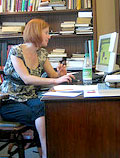
Olsson's is a locally Owned & Operated, Independent chain of six book and recorded music stores in the Washington, D.C. area, started by John Olsson in 1972. Elizabeth Frengel worked at Olsson's Lansburgh/Penn Quarter store before joining the office staff. Each week, she sends out a rundown on some of her favorite reads.

Tuesday, May 06, 2008

Antony & Cleopatra


I got the chance to see Antony & Cleopatra on stage at the new Sidney Harman Hall last week. The Shakespeare Theatre Company's F Street digs are impressive: sleek and sumptuous at the same time. And as for the play, I think it's Shakespeare near the top of his game. (The top, for me, are the history plays and the one that shall not be named.)

You, my faithful readers, I am sure don't need a recap. But for the sake of completeness, Antony & Cleopatra is a tragedy of mad love and betrayal set during the run-up of the Roman Empire. Mark Antony has shacked up with Cleopatra in Egypt, deaf to all entreaties from his homeland. When Antony's wife, Fulvia, dies suddenly, he at last hears the call of duty and returns to Rome. Octavius Caesar sees an opportunity to strengthen the Triumvirate (and keep Antony closer at hand) by offering his sister's, Octavia's, hand in marriage.

But Cleopatra's pull proves too beguiling; Antony leaves Rome and Octavia, delivering an unforgivable blow to both brother and country.

Antony struggles with the impossible choice between loyalty to Empire and loyalty to love, making the play a study of character and politicking, certainly. But Antony & Cleopatra also contains startling poetry and a heart-wrenching death scene that I would argue takes pride of place in Shakespeare's oeuvre.

What's more, Antony & Cleopatra is fast-paced, almost suspenseful (even though, it being Shakespearean tragedy, we know how the major players will meet their end). The drama moves deftly between Egypt and Rome, and one of the curiously modern charms is how Antony refers to Cleopatra as his "Egypt." Doesn't that say it all?

Under Michael's Kahn's direction, the setting is classical and the acting is strong.

Adding to the enjoyment is the familiar ring of many phrases that have worked their way into the works of some of my favorite British mystery writers, known to borrow heavily from Shakespeare. The title of Dorothy L. Sayers' Gaudy Night, for example, had to have been drawn from one of Antony's most determined speeches:
but now I'll set my teeth,
And send to darkness all that stop me. Come,
Let's have one other gaudy night: call to me
All my sad captains; fill our bowls once more:
Let's mock the midnight bell.
And just the other evening, as I was reading Minnette Walters' The Scold's Bridle, I happened upon a reference to these immortal lines from Cleopatra:
My salad days,
When I was green in judgement: cold in blood,
To say as I said then! But come, away;
Get me ink and paper
There are many more poetically prophetic moments such as these, but I'll leave you to discover them for yourselves. Antony & Cleopatra is running as part of the Roman Repertory along with Julius Caesar now through July 6. Both a must-see.

BTW, I'm off next week for another quick dash across the pond to my favorite city in the world, London. I'll be sure to update you on all the literary happenings upon my return.

Happy reading until then,
Elizabeth Frengel
Monday, April 28, 2008

What's So Cosy About Murder?

Isn't it odd that with all the poisonings, garrottings, stabbings, and hits and runs, the work of one of my favorite authors is generally categorized as cosy? I realize the likes of Miss Marple, Hercule Poirot and Arthur Hastings rarely meet face to face with any real physical danger. And I suppose it does get pretty cozy when the players in Agatha Christie's mysterious dramas find themselves rounded up in the drawing room and falling, one by one, under the suspicion of murder. Still, it's that little verbal irony that adds to the genre's appeal.

Take the gruesome death by strychnine poisoning depicted in the first of Christie's impossibly (but happily) long run of crime-detection classics: The Mysterious Affair at Styles. Wealthy Emily Inglethorp experiences paroxysms so violent, they send her sailing toward the peak of her 14-foot ceilings.

Inconveniently enough, Mrs. Inglethorp had altered her will earlier that afternoon.

Absurdities and all, I've been doing a lot of reading about Agatha Christie, who as devotees will know found herself at the center of a sensational mystery -- perhaps of her own making -- in December 1926. Her life, work and subsequent ensconcement as the Queen of Crime have given me an idea for a children's book I'd like to write. I'll stand mum right there, not because I'm afraid I'll jinx the project (in fact, I think the more people I tell, the more likely I am to follow through) but because I'm hoping to interest a publisher in the idea.

In any case, I can recommend two intriguing adult treatments of Christie's mysterious disappearance from Styles, her real-life home, bought with her first husband, Colonel Archibald Christie, in Sunningdale, Berkshire. In case you don't know the story, Christie had recently published The Murder of Roger Ackroyd (an ingenious whodunit that not only established her place in the Golden Age of crime fiction but also brought her relative fame) when Archie announced he was in love with a family friend, Nancy Neele, and demanded a divorce from Agatha. Distressed, Agatha drove off late that Friday evening in December. Her Morris Cowley was discovered the next day in Surrey, rolled off an embankment and at rest against a tree with its headlights on and Christie's fur coat, expired driver's license and attache case inside it.

After a manic police and press investigation -- during which Archie was briefly suspected of murder -- Agatha resurfaced at a spa in Harrogate, where she'd registered under the name of Mrs. Teresa Neele. Archie and her family maintain, even to this day, that the renowned crime novelist suffered from temporary amnesia.

Agatha Christie and the Eleven Missing Days, by Jared Cade (Peter Owen, $30.95) is a thorough reconstruction of the events leading up to Christie's disappearance, the race to find her, and the aftermath of her reemergence. Cade combs through newspaper accounts, interviews witnesses from the time and puts forth his own theory about the motivations behind Agatha Christie's most curious behavior. A work of nonfiction that's as absorbing as almost crime novel out there today.

Equally fascinating is a fictional spin on Christie's so-called lost days by Carole Owens. The Lost Days of Agatha Christie (Cottage Press, out of print) takes a risky approach to getting to the bottom of her disappearance. Some twenty years after the fact, Christie agrees to spend one afternoon in the company of an up-and-coming psychiatrist, with the hope that the session will help her recover her memory of those eleven days.

I admit I was skeptical at first, but found Owens' depiction of Christie thoroughly convincing. Perhaps one can't recover deeply repressed memories in the course of one afternoon, but nevertheless, the idea put forth for Agatha's desire to disappear (to shield herself from perhaps very real physical danger) is both shocking and insightful.

Excellent books by and about an excellent figure in British literature.

Happy reading,
Elizabeth Frengel
Thursday, April 24, 2008

Lionizing the Library

Flipping through the latest Library Journal last night, a blurb about one their bloggers who's running a series about references to libraries in literature caught my eye. The mention made me think of an excellent children's book on the subject: Library Lion, written by Michelle Knudsen and illustrated by Kevin Hawkes.

Book CoverLions have always seemed an inveterate symbol of the bibliotheque -- consider the stone sentinels outside the New York Public Library on Fifth Avenue as one obvious example. Perhaps it is cliché, but where there are books, cats never seem to be too far away. Among more than 50 colleagues and bookish-minded friends, I think I can count perhaps one or two who don't have or take a shine to felines.

In any case, it's likely that the book-cat continuum makes Library Lion almost perfect in concept. The storyline strikes just the right balance between the real and the absurd. A lion wanders into the public library and develops an unnatural attachment to story hour. Miss Merriweather, the head librarian, sees no problem, so long as the beast keeps quiet and follows the rules. No random roaring, in other words.

Mr. McBee, the circ-desk chief, isn't so sure. He's more of the hard-line librarian breed and sits back and waits for the lion to make the inevitable false step.

A crisis ensues, of course, and the lesson learned is a charming one in both tolerance and discretion. Along the way, Knudsen and Hawkes have great fun with the old-librarian stereotypes. Miss Merriweather has just the sort of severe bun and half-moon specs you've come to expect. But her wit and sensitivity will surprise. Mr. McBee, well, he's the one who needs to break out of the dusty mold.

Library Lion is published by Candlewick Press and is available for $16.99. Worth every cent.

Happy reading,
Elizabeth Frengel
Monday, April 07, 2008

A New York City Nightmare

Rosemary's Baby is one of those rare cases of which the film is just as good (as in complex and riveting) as the novel.

If you've never experienced either, you're missing out.

The film (directed by Roman Polanski and starring the ineffable Ruth Gordon as Minnie Castevet, as well as Sidney Blackmer, Ralph Bellamy, John Cassavetes and Mia Farrow) dramatizes Ira Levin's brilliantly crafted novel with hardly a single deviation.

In case you don't know the story behind Rosemary's Baby here's a short sum-up: Rosemary and Guy Woodhouse are newlyweds who score an apartment in New York's coveted 19th-century building, the Bramford. Like much in the world that is high profile, the Bramford has a bad rep to precede it -- one that includes cannibalism and satanic witchery.

Rosemary makes over the apartment, gets chummy with her neighbors, the Castevets, and finds out she's pregnant. Bizarre dreams, strange chantings filtering through the apartment walls, and spurious behavior from her husband lead Rosemary to believe that her baby is being bred for some devilish ritual.

The absurdity of Rosemary's situation and the loss she finds herself at to explain it to herself and those she hopes can help her are writ painfully large in the book and film. Devil-worship seems slightly ridiculous in the twenty-first century. And yet, there are still -- even today -- those who believe. But who would believe Rosemary? This, perhaps more than the satanism, is what makes Rosemary's Baby so creepy and compelling.

In some ways, I almost like the film more, because even after countless (10 or more?) viewings, I always notice some new, subtle little clue that feeds Rosemary's paranoia. Guy slips away on the flimsiest pretexts. To get an ice-cream cone in the middle of the night, for example, when pregnant Rosemary is supposed to be the one with the yens.

In the book, the clues to Guy's and the Castavets' deception are made a bit more explicit. But the pacing is spot-on. And in the book's defense, I think Rosemary's character is stronger, smarter (she reads Dickens and Gibbon's Decline and Fall, to give you an example) and less willing to give in to the idea that she's being persecuted than as she's played by Mia Farrow. But Mia Farrow's creation is just as believable, if not quite as likable.

I also like the character of Hutch (a British transplant who writes children's adventure stories), which a gets a bit more play in the book than the film. But this is really splitting hairs over what are, in my view, two brilliant literary works.

I took a quick trip to New York City the weekend before last, to meet up with a friend of mine from London who was working a sale at Christie's, and brought the book with me to read on the train. It was just the sort of NY-atmosphere I was looking for.

Levin's 1967 novel is still in print (I told my friend Jules that I thought it was out of print -- mea culpa) and available from Signet for $7.99. Roman Polanski's directorial masterpiece is available on DVD for $9.99. I highly recommend both.

Cheers,
Elizabeth Frengel
Wednesday, March 26, 2008

Back in Black

It's perhaps not an accident that Booker Prize-winner John Banville assumes the writerly mask Benjamin Black for his latest work, a noir-styled mystery called Christine Falls.

Set in the 1950s, this novel about Quirke, a pathologist who finds out too much about a black-market baby scheme, is very dark indeed. The narrative moves almost seamlessly between Dublin and Boston, where babies are farmed out to select "catholic" families and reared for higher orders. While there's a holy front on the operation, our hero learns the hard way that at bottom, it's still trafficking in human souls.

What's remarkable about Christine Falls is not so much the story line (though the pacing is perfectly pitched) as the exquisite way in which Banville (okay, Black) draws out moral corruption, and exposes it from every angle.

An abusive and not very smart husband who accidentally kills one of these babies uses St. Mary's secret to establish his dream limo service. And let me tell you, I spent the better part of this novel wishing for his comeuppance.

Small contrivances appear now and again, such as the plot twist that takes Quirke to America and seats him in the limo of a most unscrupulous driver. But this is still a novel that's beautifully written and full of emotion that's piercingly observed. Case in point: "When Phoebe spoke Delia's name now he felt as an adulterer might feel when his wife makes casual mention of the family friend who is his secret lover." Banville nails that secretive pride a paralyzing guilt in one fell sentence.

And there's this one, which I think captures the dark illusiveness of Christine Falls at its core: "Then she was gone, leaving a faint wraith of cigarette smoke on the air, the pallid blue ghost of herself."

Christine Falls is available in paperback from Picador for $15.

Enjoy,
Elizabeth Frengel
Staff Photo

Elizabeth Frengel worked at the Lansburgh/Penn Quarter store from 2005 to 2006 and now works on-call with the crew in book ordering. She is close to finishing a master's in library science at Catholic University and is employed almost full time at American University in the reference, cataloging and special collections divisions. She also teaches writing at AU. Each week, she sends out a rundown on some of her favorite books.

Powered by Blogger